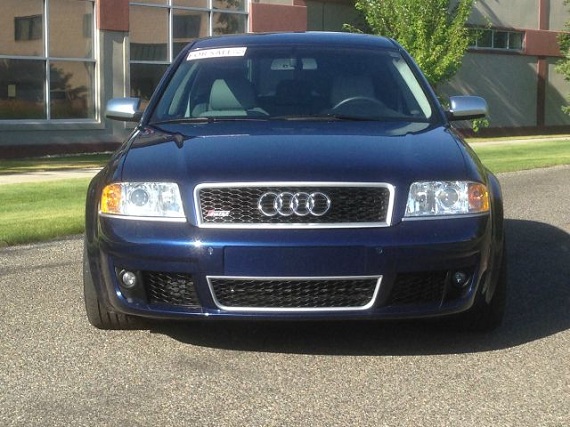
Up until the early 2000s, Audi always did things a little differently than its countrymen. Critics and enthusiasts have sometimes criticized the designs for not being optimal, overly complicated or ill-timed. But get into a RS car – any RS car – and it’s hard not to be completely thrilled. Audi certainly pulled out the stops for it’s top of the line, quattro GmbH assembled super-sedans and avants; the great details abound. Subtly flared fenders, special bumpers, larger wheels and massive brakes, lowered ride height and signature twin exhaust became the blueprint for the RS4 and RS5 to follow and hinted at the new bar that Audi set, but under the hood lurked something special in the RS6. Like the S6 the power was derived from a V8, but in the RS6 two turbochargers boosted performance to 440 horsepower with torque to match. The power was seamless and unabated; more a freight train that never let up than a rush of power. This car is deceptively fast, so quiet and unassuming it really was the ultimate Q-ship of its time. I was lucky enough to push one of these cars to its limit when new around Le Circuit Mont Tremblant, and while it’s no lightweight sports car, the amount of speed and grip it generates is otherworldly, and it can easily keep up with many cars that should be quicker. Inside you were bathed in luxury; soft touch plastics, warm colors on the dashboard, excellent seats that managed to both be supportive and comfortable. There were small details too that helped to make the RS6 feel even more exclusive; the Alcantara headliner, alternating color piping on the leather, rich wood accents and carbon fiber details that were sprinkled in just the right proportions to make this car the ultimate Autobahn weapon:
Author: Carter
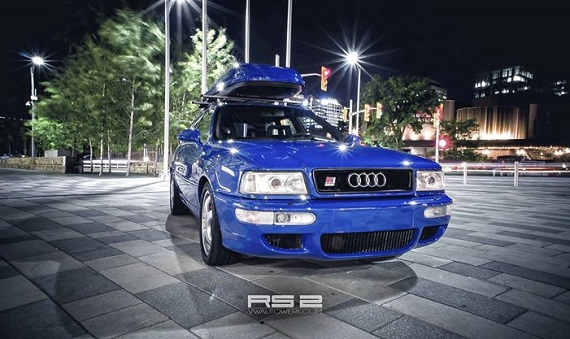
In the high performance, exclusive world of Audi’s RS models, most enthusiasts believe they never got it quite as right as they did with the original model. Sure, the RS4s, RS6s, RS5s and TTRSs are impressive, fast and luxurious. They’ll all decimate the roads on the way to your destination, with little regard for supposedly faster marque’s badges. But there was something that was extra special and just a bit more magical about the original RS2; the first of the super wagons, the splashes of red and RS blue were like a poison dart frog – a warning to the rest of the big boys that this little wagon meant business. Packed with a special 311 horsepower Porsche-messaged version of the venerable 20 valve turbocharged inline-5, the RS2 was very special indeed. Power made it to the ground through all four wheels mated to a 6-speed manual transmission with Brembo brakes and Porsche wheels; the small chassis Audi could break 5 seconds in a 0-60 sprint and was good for over 160 m.p.h. making it one of the fastest road cars in the 1990s. About 3,000 of these cars were made, making them not quite as rare as one would expect given how infrequently we see them for sale – but there’s a stunning low mile example today on VW Vortex:
CLICK FOR DETAILS: 1995 Audi RS2 Avant on VW Vortex
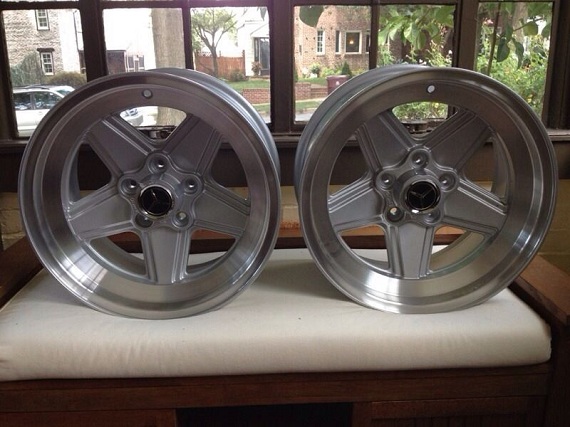
9 CommentsIt’s a rainy day here in New England, so I spent some time finding my favorite wheels on Ebay. Most of these are period option or aftermarket wheels, but all of them are pretty cool. I especially love the BMW Ronal wheels, the ATS AMG wheels in nearly new shape and the amazing BBS magnesium Bugatti EB110 wheels. Which are your favorite?
Update: thanks to reader KevinR for correctly spotting the Mercedes-Benz wheels were Centra Type 31s. Thanks!
CLICK FOR DETAILS: ATS AMG 16×8 5×112 Wheels on eBay
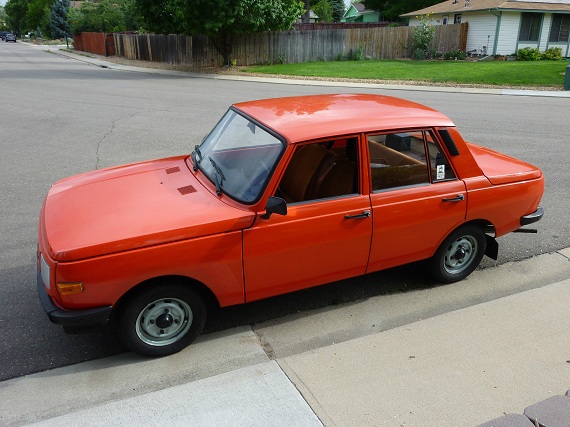
2 CommentsProletariat of the world, unite in celebration! It’s not often that we get to see a car produced in the German Demoractic Republic – better known to you and me as East Germany. When we do see one, it’s often the much loved for being horrible Trabant that steals the limelight. So you know you’ve got something special when the car in question is referred to as “the other car made in the GDR”. It was a stunner, too – with such innovation as windows, wheels and even seats. The seats even had a class system – no socialist bench seating here! By separating the driver into their own separate seat, this progressive automobile showed that it was a world beater. Who said the Communists couldn’t think outside of the box? Speaking of boxes, did I mention that sleek exterior? It was a face only a Yugo’s mother could love, but compared to the Trabant – a car stuck believing 1955 was the future – the Wartburg 353 seemed to be emerging from the jet-age. Pioneering the concept that less moving parts was better, the Wartburg’s 2-stroke 3 cylinder engine was the prototype for the Tesla motor; it took Elon Musk 40 years of research to reduce the Wartburg’s 7 moving engine parts to only one! Rare to see..well, anywhere, check out this car that gave Captialist designers nightmares:
CLICK FOR DETAILS: 1977 Wartburg 353 on eBay
Comments closedI suppose it’s beating a dead horse just a bit, but it’s astounding what a good deal the overlooked 944 Turbo is these days. You can get a very clean early 86 944 Turbo for around $10,000 – significantly less than what an equivilant E30 M3, Quattro or 190E 16V will cost you. Performance from the turbocharged inline-4 will surprise the other three legends, too. Even in early 220 horsepower specification, the 944 Turbo will easily out accelerate, out turn and out brake the other three. The most aerodynamic of the three, it will also return the best fuel economy on a long trip. The only downside is that, unlike the others, the rear seats are mostly useless to anyone who has legs; but they’re there in a pinch, and the versatility of the hatch in part makes up for some of the downside. But for Porsche, it wasn’t quite enough to have a car capable of besting its contemporaries, so in 1988 Porsche upped the ante with the “S”; an additional 30 horsepower, trick M030 Koni suspension, limited slip differential and forged Fuchs wheels led the list of changes that were carried over into 1989: