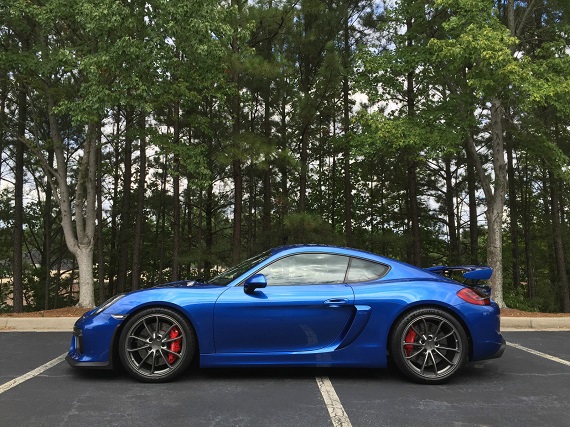
In my write-up of the new GT3 RS, I mentioned the Cayman GT4 as a useful alternative for those seeking a traditional manual in their performance car now that Porsche has decided the GT3 RS will no longer come equipped with one. So why not have a look at the new GT4? Like the GT variants with which we are all so familiar for the 911, the Cayman GT4 takes aim at the track. It uses the 3.8 liter flat-six from the 911 Carrera S with 380 hp, sources much of its stiffer suspension from the GT3, and drivers must accept some compromises to refinement and everyday usability in the name of less weight. Those weight savings are countered by weight gains from much of the more stout components on board meaning the GT4 comes in at nearly the same weight as the Cayman GTS. In appearance, the GT4 is clearly distinguished from its siblings by a front fascia akin to that of the GT3 and GT3 RS, its lowered ride height, more pronounced rear air inlets, and a rear wing. Suffice it to say, no one will confuse the GT4 for a standard Cayman. And, of course, the only transmission on offer is a 6-speed manual.
Author: Rob
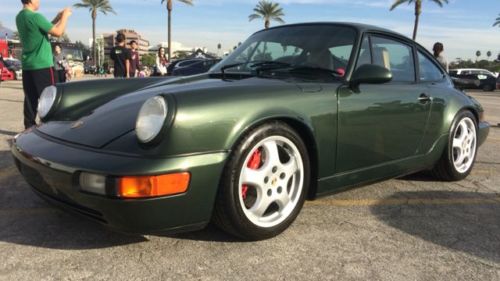
This is not a 911 RS America. I make that clear only because when I first came upon this car I originally mistook it for a RS America and wanted to have a closer look. I was confused by the color, which is not one of the standard colors of the RS America. In fact, this color itself is fairly rare among 964s in general. The specific color isn’t stated, though it is said to be the car’s original color, and I would hazard a guess that it’s Oak Green Metallic. The lack of hi-res pictures don’t help in this regard. So why does it look like a RS America? Because it’s had a couple modifications – the suspension has been lowered and it’s sporting the whale tail of the RS America. When the seller says the car looks like a RS America, I agree. At least with regard to the exterior. Since I’ve always liked the basic look of the RS America and I also enjoy these darker shades of metallic green this 964 really drew me in and overall the condition looks quite good. The 964 itself continues to grow on me and I think right now their values sit in a pretty nice spot for those who desire an air-cooled 911 that possesses a mix of the modern and the classic.
CLICK FOR DETAILS: 1993 Porsche 911 Carrera 2 Coupe on eBay
3 CommentsWe’re experiencing some uncommon December warmth here in the Mid-Atlantic (and hopefully elsewhere as well) so why not reinvigorate our senses with a Cabriolet. Here we have a Slate Blue Metallic 1983 Porsche 911SC Cabriolet, located in California, with 116,526 miles on it. 1983 was the first year a true convertible was offered for the 911, a point that is somewhat surprising given Porsche’s penchant for producing sports cars featuring some form of open-top motoring. While the Soft-window Targa provided a nearly identical airiness it’s very limited production run – only produced from 1967 to 1969 – tends to set them apart from the rest of the 911s leaving us with only the standard Targa, with which we are very familiar. Granted, for a sports cars the lack of a Cabriolet isn’t necessarily a significant negative, but beginning with the 356 Porsche had demonstrated an ability to craft quality sports cars that were excellent performers even without a roof. Perhaps they felt the 911 was a different animal; perhaps they were concerned about increasingly stringent safety requirements – these had lead to their production of the Soft-window Targa in the first place. Whatever the reason the 911 was around nearly twenty years before a Cabriolet was produced and since that time they’ve always been with us.
CLICK FOR DETAILS: 1983 Porsche 911SC Cabriolet on eBay
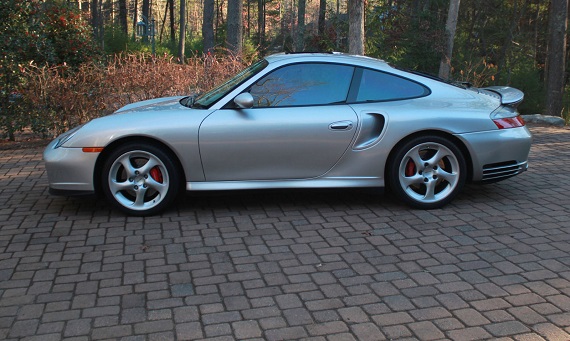
3 CommentsI’m not always the best person to write about the 911 Turbo when it comes to performance value. In part that is because I live in a city and drive a car with only 142 hp (though it is pretty light) and can’t even remember the last time I used a gear past third. And even third gear is only used for dawdling. So, power is never an issue and having three times as much horsepower almost seems confusing. That said, for most people this is not their typical experience and even I have driven much quicker cars and fully understand the allure of that extra power. While not necessarily what I would prioritize I do understand it, or in the words of Frasier Crane, “if less is more, just think how much more more will be!” Let’s get to the car here, which comes from our consistent favorite when searching for that elusive combination of supercar performance and reasonable cost: the Porsche 996TT. As the first of the water-cooled Turbos and with styling that most feel is a departure from the 911’s iconic design, the 996TT has long been a bargain and mainstay for those in search of the most bang for their buck. But that is starting to change, even if slowly. As prices for air-cooled Turbos create an ever widening gap between their values and those of their water-cooled successors, buyers appear to be increasingly turning their attention to these unloved models. We are even beginning to see collectors take notice, though for the most part that seems to be restricted to the GT2 and GT3 for now. Could it be that even the 996TT will soon see a sharp rise in value and value-conscious buyers again will have to search for the next alternative? The example we see here may shed some light on that question: an Artic Silver Metallic 2001 Porsche 911 Turbo Coupe, located in North Carolina, with 16,430 miles on it.
CLICK FOR DETAILS: 2001 Porsche 911 Turbo Coupe on eBay
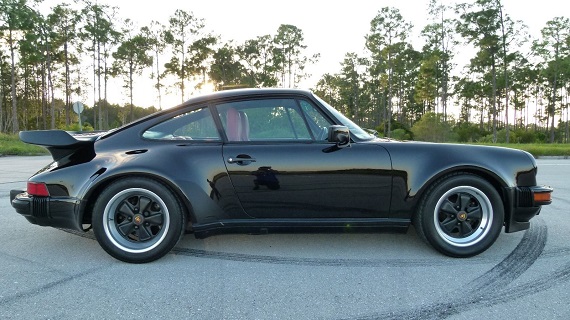
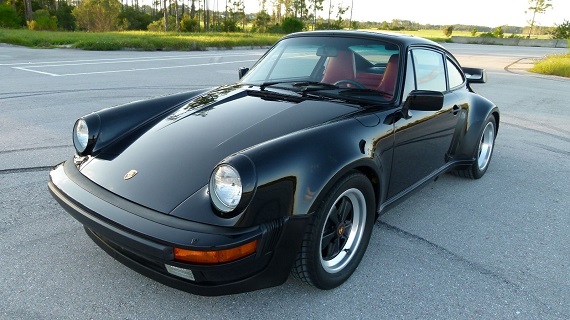
Comments closedLet’s check in on the 930 market, or at least near the top end of the 930 market. The example we see here is a Black 1986 Porsche 930 Coupe, located in Florida, with a Cancan Red leather interior and only 5,938 miles on it. The interior and mileage both point to this as a collector-quality 930 that likely has spent most of its life waiting for just such a moment when it can be put up for sale. Given its asking price, we probably should not expect that situation to change. Collector status aside, 1986 was the first year Porsche returned the 930 to our shores and though emissions requirements still brought about some power losses relative to its European brethren the 930 would have been welcomed wholeheartedly back into the Porsche stable. The menacing rear-drive rear-engine coupe was finally back with us and drivers were once again required to devote full attention to their actions when piloting these wonderful, though touchy, machines.