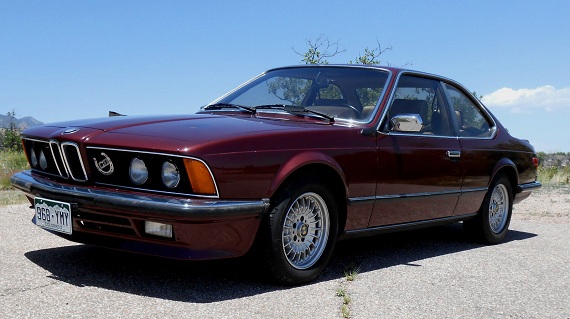
Witness exhibit C in my anti-E30 M3 campaign. Like yesterday’s 1988 635CSi, this is another clean and tidy, well presented E24. But unlike yesterday’s end of the run car, this is a mid-year non-M spec car that I would generally consider the least appealing of the bunch. So what’s special about this one? Well, it’s a 5-speed car, always a plus amongst the big 6s. It’s got lower miles, too – only 68,000 in this case; that’s less than 2,500 on average if you’re counting. It’s all original, too – right down to the TRX wheels and tires. It has the unique Buffalo hide leather – an interior usually seen in the M cars but less frequently in normal production models. But in my mind I love it because it’s a Euro-spec car with a documented history, and an interesting one at that:
Author: Carter
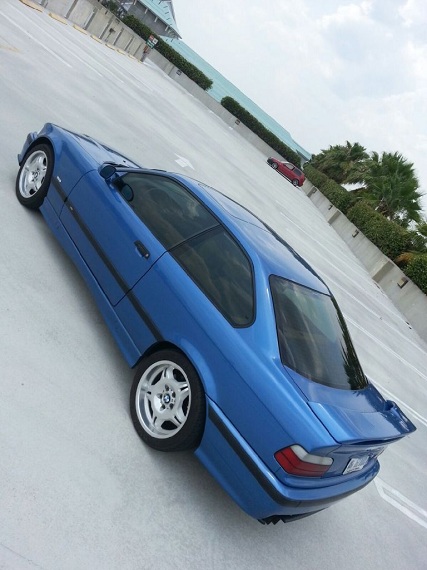
Next in my continuing series of “Why buy an E30 M3 right now?” comes…a M3. What’s going on? For as bad as I’d consider the value of the E30 M3 right now, it’s hard to argue with the value of the E36 and E46 M3. Out of the box, they did everything better than the E30 did. They’re easily the track equal of the E30 and have some added luxury and refinement. One could argue that the build quality went down a bit with the E36, but find a nice example and you’ll soon forget that. Aftermarket suppliers abound, as this is the GTi of the BMW world, parts are plentiful and relatively cheap, and they look and sound great. What’s not to like? Get one in a great color with lower miles and it’s pure win:
CLICK FOR DETAILS: 1997 BMW M3 on eBay
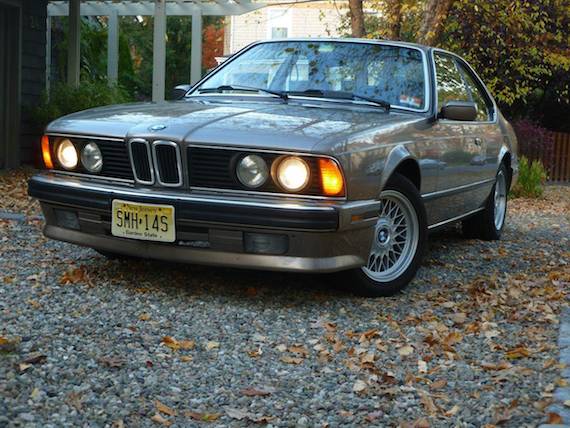
1 CommentBy 1988, BMW’s lineup consisted of a few dinosaurs from the 1970s which remarkably still were considered reasonably fresh and competitive in the market. First was the E28 5 series; a refresh itself of the earlier E12 design, most of the technology and the layout seemed fairly dated by 1988; if nothing else, certainly the bumpers hinted at a less than harmonious relationship between Paul Bracq and the United States DOT. The same could be said of the E24 6 series, now entering its 12th year of production. Granted, like the E28 it had received a host of updates in the early 1980s that kept in on top of the heap; for both platforms, the screaming S38 powerplant uttered the last roar in the U.S. for both legendary chassis. But unlike the E28, the E24 was granted one last stay of execution before the launch of the 8 series. With some light facial work, a nip and a tuck it suddenly looked like a much more modern car and in my mind the prettiest of the E24s outside of the original and unspoiled 630CS. Most of these last of the run 6’s seemed to be automatic, but a precious few were imported with a 5-speed manual – giving a sporty and less expensive alternative to those not needing the motivation of the M6. Today there is one such 635CSi for sale on Hemmings:
CLICK FOR DETAILS: 1988 BMW 635CSi on Hemmings Motor News
3 CommentsAnother day, another story about an Audi I owned. This time I’ll evoke memories of the “dragon wagon” – my 1989 Audi 200 Turbo Quattro Avant. It seemed like a great idea at the time; I saw an advertisement for an “Audi Quattro Wagon” that was sitting in a field in New Hampshire. When I arrived with trailer to pick it up, it turned over and even ran briefly with ether but wouldn’t move. The seller wasn’t the original owner. He had picked the car up from an auction and didn’t know why it wouldn’t run or move. Over the next few months it sat in my friend’s driveway as I slowly diagnosed the problems. It was remarkably clean, and I was able to figure out that the original owner had cared for the car reasonably well – but it obviously hit a point where the repairs and condition exceeded the then-owner’s threshold for tolerance and they donated the vehicle to a charity. That probably should have told me something then, but I pushed on, first diagnosing the run condition (fuel pressure regulator leaking and bad) and then figuring out why it wouldn’t move – the clutch was completely gone.
I tried with a friend to replace the clutch without a lift, but sufficed to say, it’s a repair on Audis that is fairly involved and eventually I gave up, choosing instead to pay a mechanic to replace it. While there, it turned out the car also needed brakes (no surprise) but it ran remarkably well considering where it came from. I then used the “dragon” for the next few years at work. The odometer didn’t work, making it easier to pile miles on – which I did. So did I pile on repairs, and like my V8 ownership the “dragon” seemed destined to provide me with countless stories. It almost ran over my co-worker (without anyone driving it). Then there was the time the voltage regulator went out and I had to alternate switching on and off every electrical item in the car to avoid toasting the battery. That’s difficult in a car where half the electrical items no longer work. There was the time a friend had to rescue me in central Connecticut after the car spewed the contents of the oil pan – twice – all over Route 84 when one of the oil cooler hoses let go. I referred to it as the hard way to do an oil change. And no story of the “dragon” would be complete without the story of my now wife driving me home from the hospital; me mostly naked after having crashed my bike into a tree at pretty high speed with some resulting broken bones. The entire ride home my poor wife apologized as she tried to come to grips with the idiosyncrasies of driving the Audi, of which there were many. Finally, after one last trip to pick her up from work a few months later where the brakes locked on I had enough; I retired the Audi and sold it to my uncle as a parts car, as he had a 1988 5000CS Quattro Avant with somewhere near 500,000 miles on it. Obviously, he needed the car more than me.
But I was wrong! The car returned to life a year later; I was contacted about an ad I placed selling the car, and after helping to broker a deal with my uncle and the new owner, the “dragon” moved on and was reborn. I saw it a few times in my travels – the new owner turned up the boost and fitted large wheels and Euro lights and it certainly looked the part. The travels of the Audi were a reminder of many things – the longevity of these well built cars, the complexity of keeping a cutting edge 1980s car running, and the devotion of the Audi fan base. Here’s my suggestion though – don’t find one in a field, buy this one instead:
CLICK FOR DETAILS: 1990 Audi 200 Turbo Quattro Avant on eBay
2 CommentsI’ve said it before, and I’ll say it again – I generally try to stay away from the E30 crowd, mostly because I really don’t think the current values on the M3 are justified. For under $10,000, it was a great track car. For under $20,000, it was a great occasional driver and memory of fun times in the DTM. At $30,000, it starts to become a show car that you’re not willing to drive to the store. Past that, it’s pure speculation and there seems to be no end in sight. Likely, that won’t be the case but if the Hemi bubble taught us anything it is that there will always be something new for people to latch on to. Of course, I watched a Mecum auction this past weekend and saw a Hemi Barracuda hammer for a few million dollars, so I guess the market on those cars still hasn’t returned to anything resembling normal.
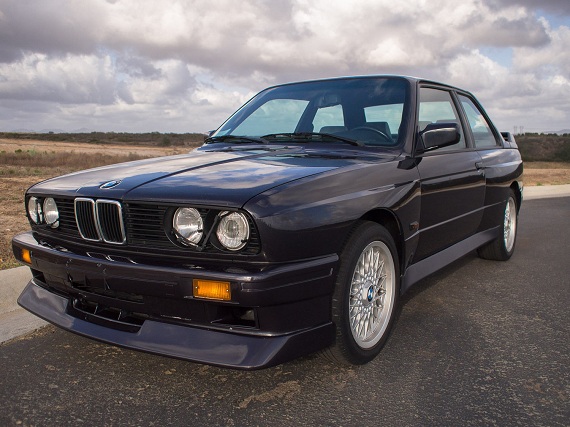
Will the E30 M3 drop back down? Well, it can’t stay on this trajectory for long, that’s for sure. Cars have tripled in value in the past two years, a trend which is simply unsustainable. They’re no longer values – they’ve become the absolute top of the 1980s BMW market outside of the ultra-exclusive M1. And why? Don’t get me wrong, the E30 M3 is a cool car. But exclusive? They made 16,000 of them, for goodness sake. Compare that to some other notable BMWs – 450-odd M1s, about the same amount of pre-war 328s, or 250 507s. To put that even into more perspective, BMW made only about 6,000 E24 M6s and a scant 2200 E28 M5s. Rarity isn’t on the side of the M3, but few have ever accused the automobile market or enthusiasts with any sense of sanity, so the climb continues. Now, in my mind there are some E30 M3s that deserve the attention and loftier prices, and the Evolution models have to be one of the most deserving. With a touch more power and a little less weight, the M3 Evolution was closer to it’s track-winning relatives than the standard production M3. As they only made 500 of each run, they’re rare to see – but the market is such that for some who got in at the right time, they’ve reached their stop on the crazy train: